

Introducing Custom Models for Accurate, Safe, and Cost-Efficient Enterprise AI with the Highest ROI
 Sushanth Raman, CEO and founder
Pallet deploys custom supply chain AI models optimized for your company’s operations, processes, and knowledge. The model is trained specifically for your business, never shared with another customer or AI lab, and can be deployed on infrastructure you control. This approach delivers the highest ROI in the industry, with AI that’s more accurate, private, and dramatically less expensive to run.
Frontier models are the most impressive general-purpose technology ever built. They were trained on the public internet, which contains most of what humanity has ever published. That breadth is what makes them remarkable, but it also makes them generalists by design. But your operation is not general.
The public internet contains nothing about your supplier relationships, customers, routing logic, and years of tribal knowledge. Therefore, frontier models can't know which customers you sell to, how much you pay to source your inventory, or receiving hours at each facility. They can't because none of that context was in their training data.
As a result, frontier models need to be separately given your business context to run. That presents two problems for enterprises running at scale: cost and privacy. The cost of running AI increases with the amount of business context, while businesses need to hand over their most valuable proprietary information to OpenAI, Anthropic, or Google.
Our solution is a custom model trained on your business, running on your infrastructure, and owned by you.
Why the economics of AI change at scale
The first wave of enterprise AI was measured in demos. The next wave will be measured in operational economics.
When AI moves from a demo to running real workflows, every transaction takes several steps: reading an input, retrieving context, making decisions, validating outputs, handling exceptions. Each step is a call to the model, and each call costs money. Run that across thousands of shipments a day, and two things happen: your costs grow with volume, and it becomes increasingly hard to predict what AI will actually cost at scale.
The answer is not always the biggest model. It's the right model for the right workflow. It's better outcomes.
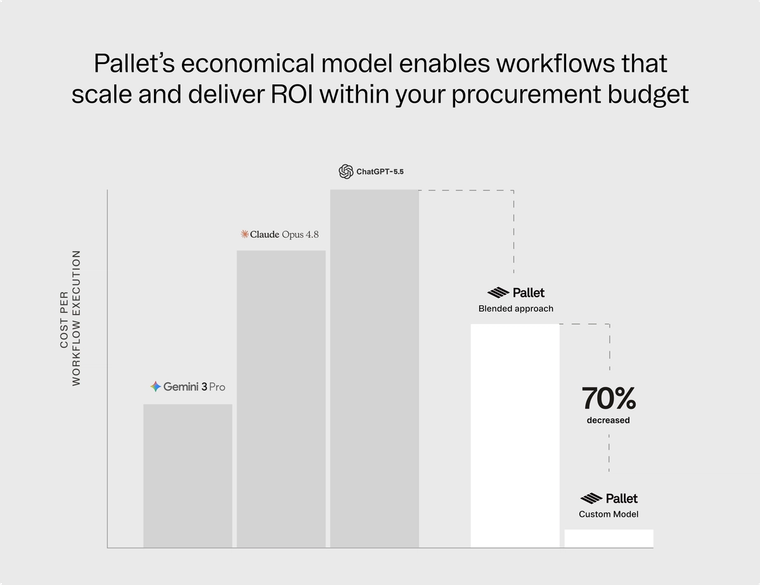
We benchmarked Pallet's blended approach and Custom Models against the leading frontier models on the same production workflows. The pattern held across every customer we tested: a model fine-tuned to your operation, running only what each step requires, costs a fraction of what it takes to route every call through a frontier model alone.
What is enterprise sovereignty and why is it important?
Your margins and enterprise value is determined by your proprietary relationships, processes, and knowledge. Ownership of your intelligence decides who captures the value your business creates and who ultimately controls the direction of your business.
Every order your agents process, every exception they resolve, every rule they learn is your operational knowhow. When that work runs entirely through a frontier provider, your knowhow flows into someone else's system. Providers have a structural incentive to move as much of that intelligence into their model as possible because once it lives in the model, it can be resold as general capability to anyone, including your competitors. You are paying to sharpen a system you don't own.
A Custom Model keeps that value inside your business. The intelligence your operation generates compounds into a model you own, not into a provider's next release.
Sovereignty is protection against a market that keeps changing. Model outages, shifting retention policies, sudden price changes, geopolitical restrictions: every one of these becomes an existential risk if a single provider sits in the critical path of your operation. Owning the model and benchmarking across open alternatives means you can keep running, and keep your leverage, no matter what any one lab decides to do next.
How Pallet trains a Custom Model for your business
More accurate, more scalable enterprise workflows, all at a fraction of the cost.
Pallet Custom Models are trained on the real workflows already running through Pallet agents. The model is dedicated to your organization and can be deployed on infrastructure you control, which gives you ownership across all three layers of the AI stack:
- The Agent layer: Pallet agents and Fabric, where your workflows run and connect to your systems.
- The Intelligence layer: a Custom Model dedicated to your operation, not shared with any other customer.
- The Compute layer: the hardware the model runs on, which can be infrastructure you control.
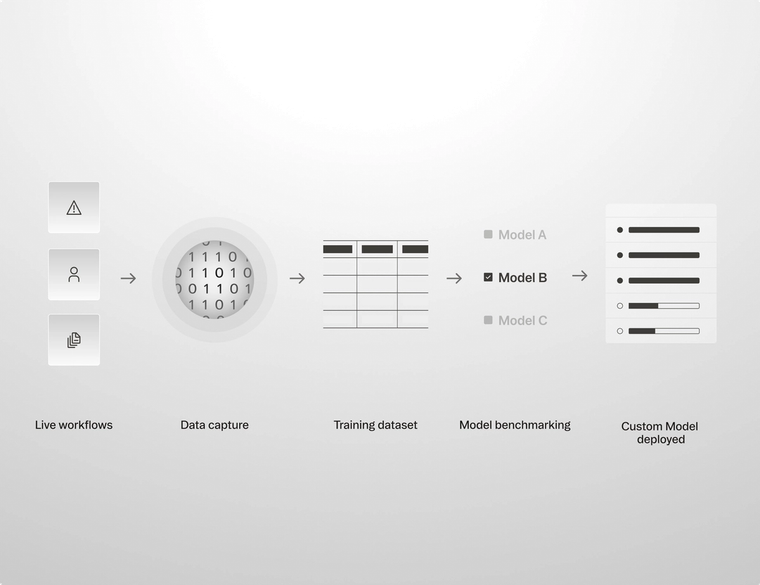
Most custom AI projects start by asking the customer to assemble a perfect training dataset, which is a difficult challenge. Pallet starts by deploying agents into production. As they process real orders, documents, and exceptions using frontier models and Pallet's memory layer, they generate what no offline dataset can: a high-quality record of your workflows at production scale.
Pallet cleans, structures, and anonymizes that data before training the model tailored to your operation. Your data is never shared with a third party or used to train anyone else's model.
Before training any Custom Model, Pallet benchmarks each customer’s workflows across leading open-source models to establish a performance baseline. We evaluate accuracy, inference speed, latency, throughput, and infrastructure cost to determine which model architecture is best suited for your operation. From there, we clean and prepare the training data, fine-tune the model, evaluate its performance, optimize inference, and deploy.
With our custom model, we deliver faster and better service to our customers. The model just knows every customer and lane preference, without having to look it up in our system every time. We have an ambitious goal to grow and having our own company model is mission-critical.
Gene Welsh
Chief Transportation Officer, Mallory Alexander International Logistics
Pallet's Enterprise Memory Layer drives accuracy. Custom Models make it scalable.
Custom Models don't replace Pallet's memory layer. They work alongside it.
Memory captures the operating knowledge that makes every business unique and retrieves the right context at the right moment, so agents handle the work the way your operation would.
But some operating patterns are stable enough that they shouldn't need to be reloaded every time. If Acme Trucking is a preferred carrier, a generic model has to be reminded of that whenever it matters. A Custom Model learns that pattern directly, so the system doesn't need to reload the same instruction every time.
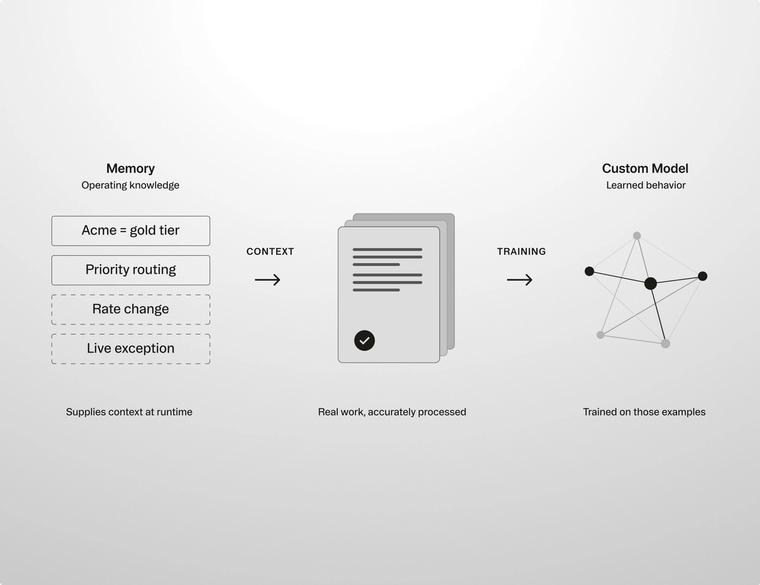
That is the division of labor. Custom Models learn the stable patterns that repeat across thousands of transactions. Memory handles what changes: new customers, updated business rules, live exceptions, and this week's edge case. Memory gives agents the right operating context. Custom Models make that intelligence faster, cheaper, and easier to apply at scale.
The AI model flywheel
As an operation grows, so does the amount of context a general-purpose model needs to carry: more rules, more customers, and more exceptions. Longer context means higher inference costs, slower responses, and eventually less consistency.
Custom Models remove that ceiling. Instead of repeatedly consuming operational knowledge, Pallet turns it into permanent capability.
Pallet agents execute the workflow. Fabric connects to your systems. The Enterprise Memory Layer captures your operational knowledge. Custom Models transform that knowledge into better intelligence your business owns. And that cycle repeats.
The future of enterprise supply chain AI is not one generic model serving every operation. It's dedicated intelligence that learns from your operation, becomes more efficient as it runs, and compounds over time.
If you want to see what an AI model trained on your operations could do, we'd love to talk.